











This is one im-peck-able efficiency.
An injured fowl in an Amsterdam zoo made historical past as the first in the world to obtain two 3D-printed beak prosthetics.
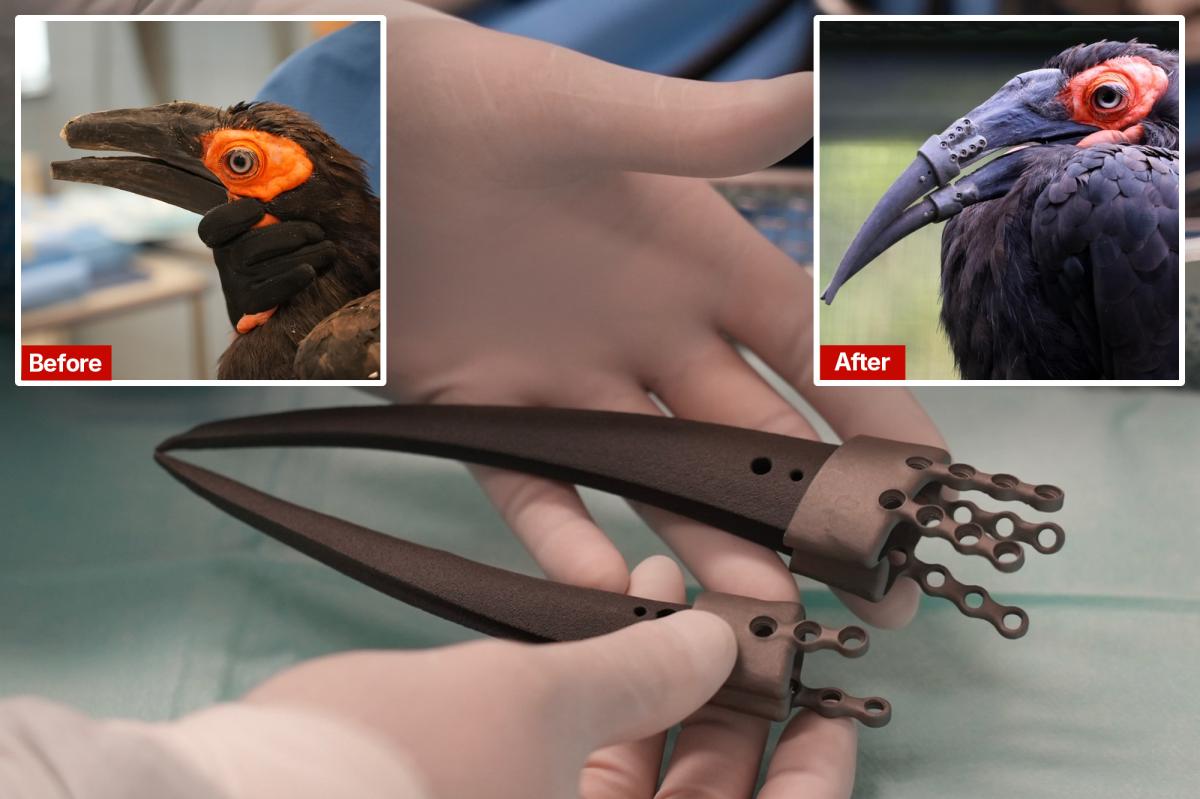
The southern floor hornbill at Artis Zoo got the custom-made synthetic beaks — printed from plastic and hooked up with screws by surgeons — to exchange his higher and decrease ones, which had both damaged, affecting his high quality of life and capability to eat.
A southern hornbill acquired two 3D-printed beak prostheses. ARTIS
“A bird that loses part of its beak loses much more than just a piece of its appearance,” Artis Zoo said on Facebook. “It meant that he could not take care of himself and could not pick up more difficult food from the ground.”
Artis Zoo, one of the oldest in the world, based in 1838, partnered with the Veterinary Medicine division at Utrecht University in the Netherlands to help the younger male fowl.
“Especially with a young bird that can still live to a very old age, we felt it was important to see if we could improve its quality of life,” the zoo said on its web site.
Although other birds have acquired one synthetic beak, this is the first time two have been launched.
“There are previous cases of birds with one beak prosthesis, but as far as is known from the scientific literature, this is the first time worldwide that a bird gets both an upper and lower beak prosthesis,” the zoo defined on Instagram.
The fowl had damaged both his higher and decrease beaks. ARTIS
The college used the damaged elements of the hornbill’s authentic beak, coupled with a scan of his head and the remaining stumps, to design two prosthetics, which were hooked up during a surgical procedure carried out by Bjorn Meij and Lucinda van Stee from the college.
The workforce feared the fowl would not acclimate to his new beaks, given that he would not really feel any sensation in it due to the plastic.
“Our biggest concern was that he would become so upset that he would stop eating. That is why we had a clear plan B in advance. The prostheses are secured with screws and can be removed again if necessary,” the zoo defined.
But on the same day of the operation, the fowl was already utilizing his new beak.
“Of course, he had to get used to the shape and the extra weight, but he actually looked comfortable right away,” the zoo said.
“The next morning, he was already picking up a mouse from the ground again. That same day, he ate independently with his new beak.”
Now, the zoo is carefully monitoring the fowl’s conduct with the prosthesis and has a plan in place in case it gets broken.
“We have also taken into account the possibility that a plastic beak part might break at some point. Therefore, spare parts are manufactured. Should it be necessary, we can replace a damaged prosthesis,” the zoo defined.
“In addition, we want to investigate whether his behavior changes.”
The Veterinary Medicine division at Utrecht University used the damaged elements of the hornbill’s authentic beak, a scan of his head and the remaining stumps, to design two prosthetics. ARTIS
The fowl has a feminine companion, and the zoo is also monitoring her conduct.
“And of course, we are curious how his partner reacts. We don’t yet know exactly how their mutual behavior will change. That will be interesting to follow,” it said.
“Research has already been conducted into the behavior of the pair. It would be interesting to compare what he does differently or more often now with his new beak.”
The zoo hopes it can welcome the couple’s infants in the future, with the assist of the father’s new beak.
“A well-functioning beak can also be important for mutual interaction and for caring for the young,” it said.
Source hyperlink