










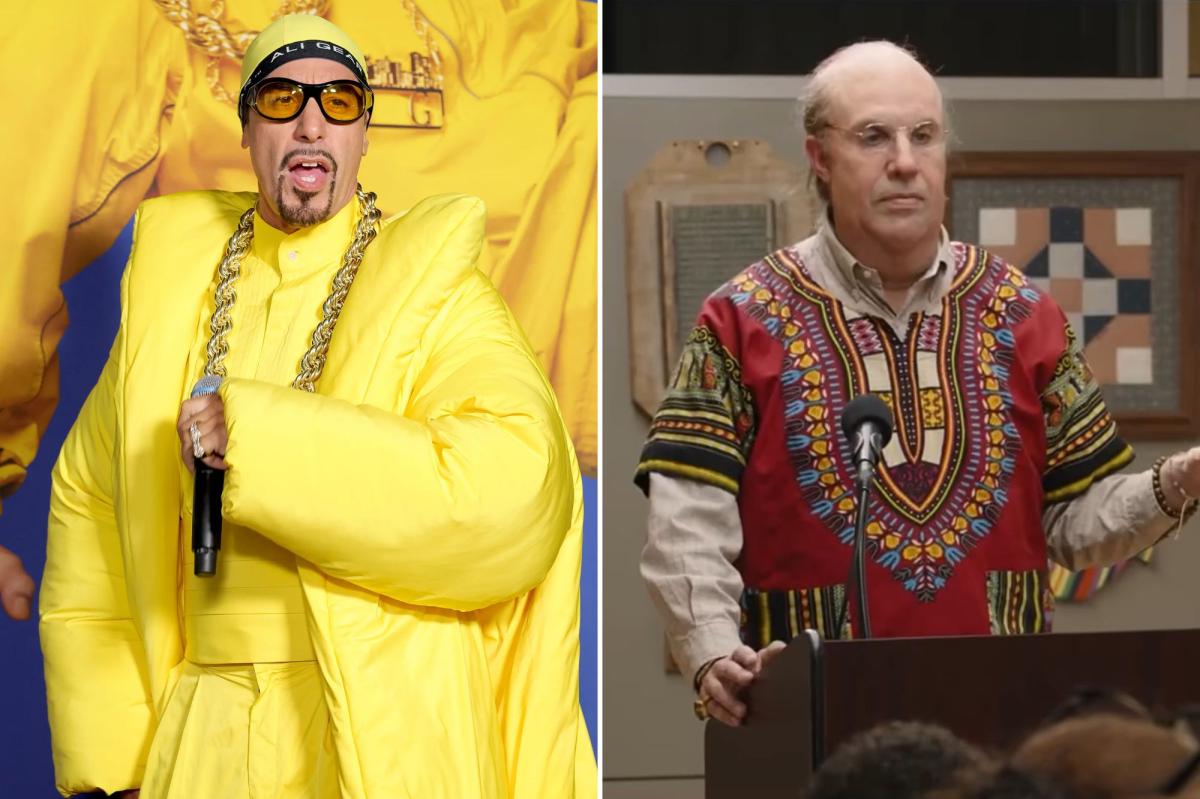
Behind the absurd outfits, garish bling, imbecilic interactions and Caribbean-cockney slang of Sacha Baron Cohen’s “Ali G: Who Iz I?” lies an unsettling indictment of how excessive the extremists have become on both ends of the spectrum since the last Ali G movie in 2002.
The premise of the mockumentary is simple. Twenty-four years after the first movie, an getting old Ali G and his pregnant accomplice Julie (Morgana Robinson) jet off to America after discovering a long-lost fax from HBO inviting him back, only to study it dates from 2004 and has since expired. Out of choices, Ali G agrees to host a racist tv present for Dirk Visser, a South African former arms vendor and producer, that includes cameos from Kari Lake, Newt Gingrich and George Santos.
As in earlier movies, the actual motion is what Cohen, in his directorial debut, gets unsuspecting folks to do. He dupes fanatics on both the radical left and the fringe proper into habits that is laborious to watch and laborious to cease watching.
Much of the stunning habits onscreen echoes an infamously disturbing examine of obedience from the Nineteen Sixties identified as the Milgram Experiment — a demented take a look at in which on a regular basis folks could be simply satisfied to ship what they believed to be lethal shocks to harmless strangers. The take a look at turned a infamous instance of atypical folks’s willingness to carry out immoral orders when instructed by authority figures.
That unsettling psychology was instructive while sitting through “Ali G: Who Iz I?” in a packed AMC movie show in Times Square as Cohen uncovered the risks of excessive prejudices across the spectrum.
On the far left, Cohen reprises his position as Dr. Nira Cain-N’Degeocello, a professor of “Afro diasporic ethnomusicology,” who units out to debunk Ali G’s claim to be black and the son of rapper A$AP Rocky. Cain-N’Degeocello presents himself as a ethical authority on racial fairness. When he introduces his clearly mistreated, unpaid black intern from Gambia to his progressive colleagues, they elevate no objections.
Sacha Baron Cohen seems as Ali G.
He then persuades one of these colleagues to break into Ali G’s lodge room and watch what he believes is Cain-N’Degeocello having sexual activity with an incapacitated Ali G. He doesn’t notice it’s a prank. Instead of intervening, the progressive colleague collects a semen pattern to submit for a DNA take a look at in the hopes of proving Ali G isn’t black.
On the far proper, native Republican chief Michael Aboud and former preacher Joshua Loudermilk agree to a plan concocted by ex-Mossad agent Colonel Erran Morad (also Cohen) to kidnap a pregnant girl, the spouse of a fictitious South American drug lord, and transport her child by drone to Mexico to stop its start on American soil. When the drone malfunctions mid-flight, leaving the child dangling in its grip, one of the males (unaware that the child is a prop) dutifully drops the child from a important peak.
Sacha Baron Cohen, Joshua Loudermilk, and Michael Aboud seem in “Ali G: Who Iz I.”
In another disturbing scene, disgraced former Republican congressman George Santos willingly participates in a recreation present where he has to throw mannequins of “illegals,” including infants, Mexicans, Muslims, homosexuals and Jews, into showers labeled with “Zyklon-B.” The recreation present phase concludes with a mass Nazi salute carried out by the contestants and reside in-studio viewers. When the recreation present ends, Santos displays on his efficiency and says he should have grabbed more infants because they were smaller and more could match in the bathe.
“Ali G: Who Iz I?” was screened in UK and US theaters for just two days, on Oct. 23 and Oct. 24, amid a firestorm of boycott and cancellation campaigns. Critics on-line slammed the Ali G character as a “deeply tired and stale” anachronism too out of contact and racially infuriating for 2026. Supporters of Cohen prompt that his previous support of Israel and public stances against antisemitism contributed to these boycott efforts.
©20thCentFox/Courtesy Everett Collection
Meanwhile, from row two of the packed AMC movie show (the only seats left), the viewers erupted with laughter all through the 89-minute screening. Sammy, a 31-year-old fan seated close by, described the movie to The Post as a “breath of fresh air and a throwback to the old type of comedy we all used to love.” Cohen, Sammy said, could concurrently make you “laugh hysterically and make you cover your eyes in shock while also sharing a deep message at the same time.”
Cohen has lengthy maintained that the critics misunderstand him. In a current essay for Time Magazine, Cohen described his characters, from Ali G to Borat and Bruno, “as vehicles to expose prejudice, bias and stupidity, though I realize not everyone sees them that way.”
Sacha Baron Cohen discusses the movie “Ali G: Who Iz I?” at The 92nd Street Y on Thursday, Oct. 22, 2026, in New York. AP Photo/Andy Kropa
He classifies his work within the custom of the bouffon, a type of mockery relationship back to Eleventh-century France that, in his phrases, “savagely undermined the people in power” by utilizing “biting and at times cruel humor to undermine systemic injustice.”
His satire of institutional authority extends to other characters, too. At a current discuss at the 92nd Street Y in Manhattan, he recalled how the United Nations refused to let him movie a General Assembly scene for “The Dictator” (2012). After studying the film script, Cohen said, the UN’s protocol committee instructed him they were “not allowed to shoot inside the United Nations [because] your movie is anti-dictatorship … [and] we [the UN] represent dictatorships and democracies, and we don’t want to really take a side.”
Jonathan Harounoff is a British creator and the host of “UNscripted with Jonathan Harounoff.”
Source hyperlink