










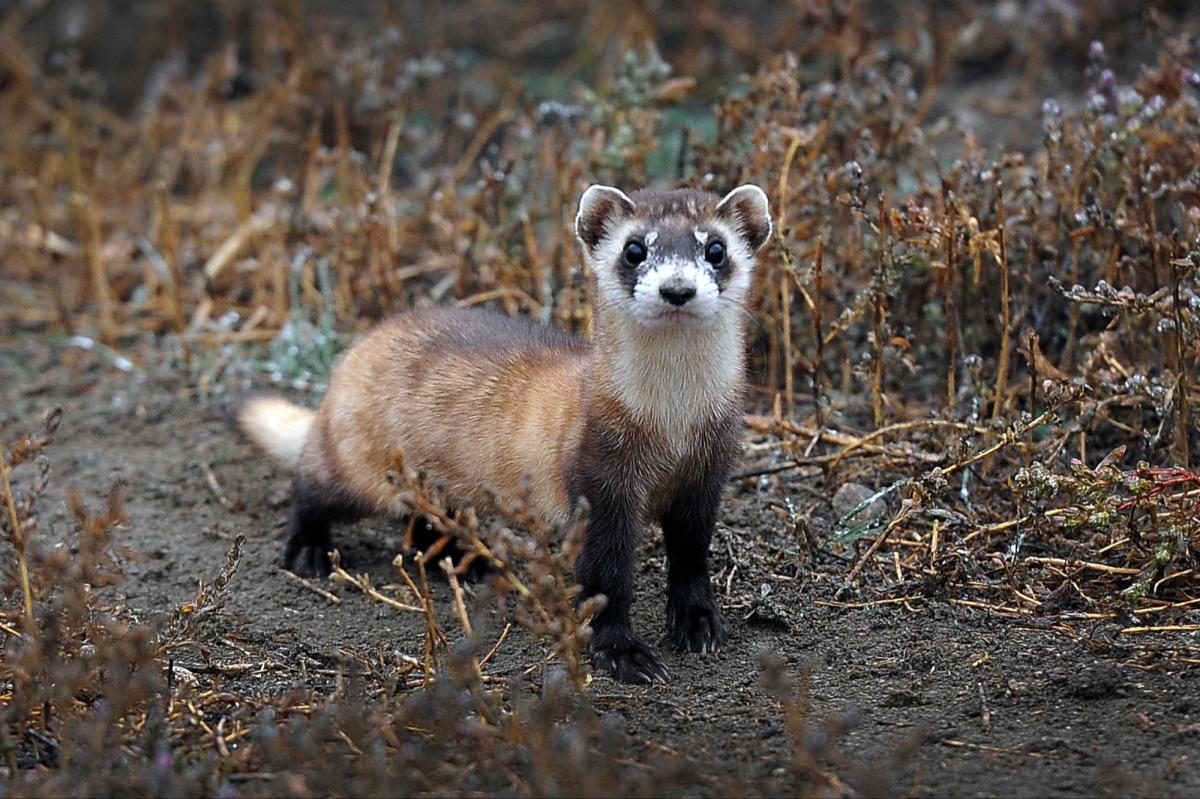
The elusive and endangered black-footed ferret is alive and properly in Badlands National Park after a long time of cautious conservation efforts to rebuild the inhabitants.
It all began in 1974, when the black-footed ferret wild inhabitants was deemed extinct.
These tiny little animals are fully nocturnal, sleeping up to 21 hours per day and waking up at evening to hunt, eat and take care of their younger, the National Park Service (NPS) said.
Black-footed ferrets’ weight loss plan consists principally of prairie canine, which were closely exterminated by ranchers and farmers, thereby impacting the black-footed ferret inhabitants in massive numbers.
In 1980, the captive inhabitants was declared extinct. Therefore, the species as a complete was now fully gone, or so wildlife biologists thought.
Black-footed ferret populations are rising in Badlands National Park after a long time of conservation efforts. Denver Post via Getty Images
However, a 12 months later, in 1981, a farm canine in Wyoming named Shep killed an animal and introduced it to his homeowners, who took it to a taxidermist.
The taxidermist knew of the black-footed ferret, alerted them to its significance and from there a relic inhabitants of 130 black-footed ferrets was found on the farm and monitored intently by wildlife biologists, according to the National Park Service.
Unfortunately, this wild inhabitants was affected by illness, and by 1987, only 18 of the unique 130 ferrets remained.
Scientists estimate that 120 black-footed ferrets now dwell in the park, including roughly 80 in Conata Basin. NPS Photo
At this level, scientists intervened, capturing the remaining ferrets and bringing them into captivity.
Those 18 ferrets served as the basis for all residing black-footed ferrets right now, the NPS said.
Now, almost 40 years later, after 20 years of reintroducing the black-footed ferrets across eight US states, Canada and Mexico, the inhabitants has seen some rebounding, but still stays one of the most endangered mammals on Earth.
Newborn black-footed ferrets at the Smithsonian Conservation Biology Institute. The Washington Post via Getty Images
In Badlands National Park, 147 black-footed ferrets were launched between 1996 and 1999 at Conata Basin in the park.
The inhabitants thrived, permitting scientists to seize 33 ferrets in 2007 and take them to Wind Cave National Park, where the NPS says 60 ferrets dwell right now.
Today, scientists estimate there are 120 black-footed ferrets residing in Badlands National Park, with around 80 of them still residing in Conata Basin.
It’s not been with out challenges to get there.
In 2008, sylvatic plague was detected in Conata Basin. It’s carried by fleas, which can be extraordinarily harmful for the ferrets when the fleas impression prairie canine, which are the majority of the black-footed ferret’s weight loss plan.
In order to reduce this danger to the ferrets and prairie canine, researchers were ready to vaccinate some ferrets in addition to dusting prairie canine holes with insecticide to stop the unfold of fleas.
Since the black-footed ferret is so endangered and prone to decline, wildlife biologists proceed to watch the Badlands inhabitants intently.
Badlands National Park stays one of the only populations of black-footed ferrets that is self-sustaining, that means they are ready to reproduce on their own and do not want to be supplemented with ferrets from captivity, the NPS said.
In whole, the National Park Service said there are about 280 ferrets residing in captivity, while the wild inhabitants is between 200 and 300.
To see the species absolutely recovered, there wants to be about 3,000 black-footed ferrets.
The species is still at danger from illness, loss of habitat and associated declines in prey.
Source hyperlink